
Research Focus: We study how roots and soil fungi interact with soils and whole-plant processes to create functional plant strategies in complex ecosystems.
Our Vision is to fundamentally change how belowground systems are perceived in both basic and applied research communities, highlighting the importance of root and rhizosphere processes to the overall health, resilience, and productivity of terrestrial ecosystems.
Key Words: Fine roots, mycorrhizal fungi, ecosystem ecology, global change biology, forest ecology, plant physiology, urban forestry, ecological modelling, biogeochemistry
Our Vision is to fundamentally change how belowground systems are perceived in both basic and applied research communities, highlighting the importance of root and rhizosphere processes to the overall health, resilience, and productivity of terrestrial ecosystems.
Key Words: Fine roots, mycorrhizal fungi, ecosystem ecology, global change biology, forest ecology, plant physiology, urban forestry, ecological modelling, biogeochemistry
Fine-root dynamics and aboveground-belowground linkages in trees
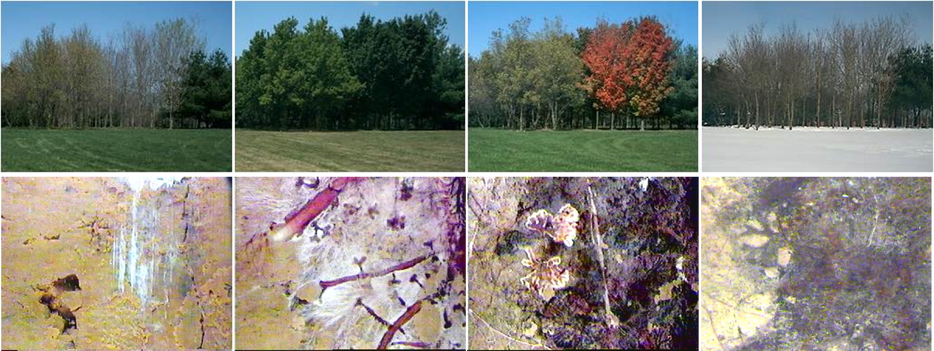
Figure. The importance and seasonal patterns of leaf emergence, maturation, and senescence are well know for most tree species (spring, summer, fall, winter seasons shown in top panels), but there is relatively little information concerning the patterns and drivers of belowground processes such as root growth and fungal dynamics (bottom panels) in most terrestrial ecosystems.
Together with the leaves and stems that we more commonly observe aboveground, the production and turnover of roots belowground play important roles mediating carbon and nutrient cycling within plants and across terrestrial ecosystems. However, basic patterns of phenology, lifespan, and decomposition of fine roots are poorly understood. In fact, compared to leaves aboveground, we know little about how different plant species allocate resources to build and maintain roots belowground, how temporal patterns in resource allocation to roots are linked with other components of trees and forests, and how these differences manifest diverse strategies for soil resource acquisition across seasons and years. Through long-term observations established in mature forestry plots at The Morton Arboretum as well as through external collaborations, we are working to understand linkages between fine-root dynamics belowground and broader patterns of plant growth and resource investment aboveground. Moreover, we are targeting our observations across a diverse suite of species representing different taxonomic groups, mycorrhizal associations, woody anatomy, fine-root traits, and whole-plant traits. From this we can develop broader understanding of functional plant variation across major plant groups that are especially relevant for the development of terrestrial biosphere models.
Relevant Publications
Wang B, ML McCormack, DM Ricciuto, X Yang, CM Iversen. Embracing fine-root system complexity in terrestrial ecosystem modeling. Global Change Biology, (2023).
Weigelt A, Mommer L, Andraczek K, Iversen...... ML McCormack. An integrated framework of plant form and function: The belowground perspective. New Phytologist 232: 42-59 (2021).
Mueller KE, DR LeCain, ML McCormack, DM Blumenthal, M Carlson, E Pendall. Root responses to climate change in a semiarid grassland. Journal of Ecology, Journal of Ecology, 106: 2176-2189 (2018).
McCormack ML, CW Fernandez, H Brooks, SG Pritchard. Production dynamics of Cenococcum geophilum ectomycorrhizas .... Fungal Ecology, 26: 11-19 (2017).
Kou L, ML McCormack, W Chen, D Guo, H Wang, W Gao, H Yang, S Li. Ectomycorrhizal morphotype, nitrogen and root distribution mediate lifespan of absorptive roots. Plant and Soil, 411: 261 (2017).
McCormack ML, KP Gaines, MP Pastore, DM Eissenstat. Early season root production in relation to leaf production among six diverse temperate tree species. Plant and Soil, 389: 121-129 (2015).
Evolutionary history and global variation in fine-root traits
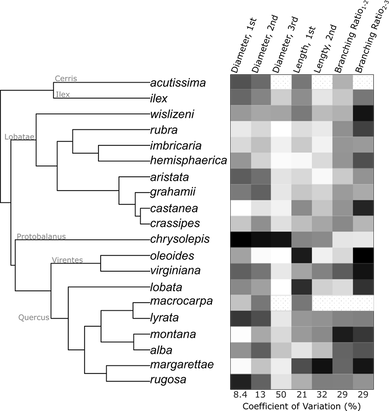 Figure. Heat map of oak root traits (dark color=larger trait values); taken McCormack et al. 2020, doi: 10.1111/nph.16804
Working with a collaborative group across Europe, China and the North America, this project utilizes an extensive collection of woody plant species at The Morton Arboretum, including many species that are underrepresented in global surveys. We are addressing basic research questions regarding how diverse fine-root strategies have evolved across species, ecosystems, and biomes. We are further interested in how these different strategies impact plant performance, ecosystem nutrient cycling and soil carbon storage. Our recent work has suggested a reduction in plant reliance on symbiotic soil fungi (i.e. mycorrhizal fungi) among more recently derived angiosperm species and these changes within the angiosperm lineage have led to broad shifts in plant strategies for belowground resource acquisition. However, it is unclear if this pattern is consistent across all plants and if the pattern of narrowing fine-root diameter and reduced fungal reliance found in angiosperms is the same with different types of mycorrhizal associations. We also have precious little understanding of how fine-root traits vary at narrower phylogenetic scales (e.g. within genus or species). At present, exceptions to the rule seem nearly as common as the expected pattern itself suggesting that there is much left to be understood and many questions left to be answered.
Figure (McCormack and Kaproth et al. unpublished). Phylogenetic tree along with summary information of fine-root trait variation for individual root orders (1st, 2nd 3rd order) among 20 species of oak (Quercus). Oak phylogeny was derived from Hipp et al. (2018) and the names of the major oak sections included are given at their respective branches. Range of variation is displayed for each fine-root trait with relatively larger values indicated in black and increasingly smaller values indicated progressively from grey to white. The coefficient of variation calculated across the 20 species is provided at the bottom of each trait column. Leaf habit of each species are also indicated with deciduous, brevi-deciduous, and evergreen indicated in light, medium, and dark green.
Relevant Publications
McCormack ML*, MA Kaproth*, E Carlson, J Cavender-Bares, PG Kennedy. Fine-root morphology and architecture are interconnected among root orders but are unrelated to climate of origin across a diverse suite of oak species. New Phytologist, (2020).
Bergmann J, A Weigelt, F van der Plas, DC Laughlin, TW Kuyper, N Guerrero-Rameriz, OJ Valverde-Barrantes, H Bruelheide, GT Freschet, CM Iversen, J Kattge, ML McCormack, IC Meier, MC Rillig, C Roumet, M Semchenko, CJ Sweeney, J van Ruijven, LM York, L Mommer, The fungal collaboration gradient dominates the root economics space in plants. Science Advances, 6: eaba3756 (2020).
Defrenne CE, ML McCormack, SD Addo-Danso, SW Simard. Intraspecific fine-root trait-environment relationships across interior Douglas-fir forests of western Canada. Plants, 8: 199 (2019).
See CR, ML McCormack, SE Hobbie, H Flores-Moreno, WL Silver, PG Kennedy. Global patterns in fine-root decomposition.... Ecology Letters, 22: 946-953 (2019).
Li F, H Hu, ML McCormack, D Feng, X Liu, W Bao. A community-level economics spectrum of fine-roots driven by nutrient limitations in subalpine forests. Journal of Ecology, 107: 1238-1249 (2019).
Li L, ML McCormack, F Chen, H Wang, Z Ma, D Guo. Different responses of absorptive roots and arbuscular mycorrhizal fungi.... Forest Ecology and Management, 433: 64-7 (2019).
Caplan JS, SJ Meiners, H Flores-Moreno, ML McCormack. Fine-root traits are linked to species dynamics in a successional plant community. Ecology, 100: e02588 (2019).
Wang C, ML McCormack, D Guo, J Li. Angiosperms and gymnosperms differ in patterns of root carbon allocation along environmental gradients. Journal of Biogeography, 46: 123-133 (2019).
Mao Z, Y Wang, ML McCormack , N Rowe, X Deng, X Yang, S Xia, J Nespoulous, RC Sidle, D Guo, A Stokes. Mechanical properties of fine roots.... Annals of Botany, mcy076 (2018).
Ma Z, D Guo, X Xu, M Lu, RD Bardgett, DM Eissenstat, ML McCormack, LO Hedin. Evolutionary history resolves global organization of root functional traits. Nature, 555: 94-97 (2018).
Li H, B Liu, ML McCormack, B Zhu, Z Ma, D Guo. Diverse belowground resource strategies underlie plant species coexistence and spatial distribution. New Phytologist, 216: 1140-1150 (2017).
McCormack ML, D Guo, CM Iversen, W Chen, DM Eissenstat, CW Fernandez, L Li, C Ma, Z Ma, H Poorter, PB Reich, M Zadworny, AE Zanne. Building a better foundation.... New Phytologist, 215: 27-37 (2017).
Freschet GT, OJ Valverde-Barrantes, CM Tucker, JM Craine, ML McCormack et al..... Climate, soil and plant functional types as drivers of global fine-root trait variation. Journal of Ecology, 105: 1182-1196 (2017).
Figure (McCormack and Kaproth et al. unpublished). Phylogenetic tree along with summary information of fine-root trait variation for individual root orders (1st, 2nd 3rd order) among 20 species of oak (Quercus). Oak phylogeny was derived from Hipp et al. (2018) and the names of the major oak sections included are given at their respective branches. Range of variation is displayed for each fine-root trait with relatively larger values indicated in black and increasingly smaller values indicated progressively from grey to white. The coefficient of variation calculated across the 20 species is provided at the bottom of each trait column. Leaf habit of each species are also indicated with deciduous, brevi-deciduous, and evergreen indicated in light, medium, and dark green.
Relevant Publications
McCormack ML*, MA Kaproth*, E Carlson, J Cavender-Bares, PG Kennedy. Fine-root morphology and architecture are interconnected among root orders but are unrelated to climate of origin across a diverse suite of oak species. New Phytologist, (2020).
Bergmann J, A Weigelt, F van der Plas, DC Laughlin, TW Kuyper, N Guerrero-Rameriz, OJ Valverde-Barrantes, H Bruelheide, GT Freschet, CM Iversen, J Kattge, ML McCormack, IC Meier, MC Rillig, C Roumet, M Semchenko, CJ Sweeney, J van Ruijven, LM York, L Mommer, The fungal collaboration gradient dominates the root economics space in plants. Science Advances, 6: eaba3756 (2020).
Defrenne CE, ML McCormack, SD Addo-Danso, SW Simard. Intraspecific fine-root trait-environment relationships across interior Douglas-fir forests of western Canada. Plants, 8: 199 (2019).
See CR, ML McCormack, SE Hobbie, H Flores-Moreno, WL Silver, PG Kennedy. Global patterns in fine-root decomposition.... Ecology Letters, 22: 946-953 (2019).
Li F, H Hu, ML McCormack, D Feng, X Liu, W Bao. A community-level economics spectrum of fine-roots driven by nutrient limitations in subalpine forests. Journal of Ecology, 107: 1238-1249 (2019).
Li L, ML McCormack, F Chen, H Wang, Z Ma, D Guo. Different responses of absorptive roots and arbuscular mycorrhizal fungi.... Forest Ecology and Management, 433: 64-7 (2019).
Caplan JS, SJ Meiners, H Flores-Moreno, ML McCormack. Fine-root traits are linked to species dynamics in a successional plant community. Ecology, 100: e02588 (2019).
Wang C, ML McCormack, D Guo, J Li. Angiosperms and gymnosperms differ in patterns of root carbon allocation along environmental gradients. Journal of Biogeography, 46: 123-133 (2019).
Mao Z, Y Wang, ML McCormack , N Rowe, X Deng, X Yang, S Xia, J Nespoulous, RC Sidle, D Guo, A Stokes. Mechanical properties of fine roots.... Annals of Botany, mcy076 (2018).
Ma Z, D Guo, X Xu, M Lu, RD Bardgett, DM Eissenstat, ML McCormack, LO Hedin. Evolutionary history resolves global organization of root functional traits. Nature, 555: 94-97 (2018).
Li H, B Liu, ML McCormack, B Zhu, Z Ma, D Guo. Diverse belowground resource strategies underlie plant species coexistence and spatial distribution. New Phytologist, 216: 1140-1150 (2017).
McCormack ML, D Guo, CM Iversen, W Chen, DM Eissenstat, CW Fernandez, L Li, C Ma, Z Ma, H Poorter, PB Reich, M Zadworny, AE Zanne. Building a better foundation.... New Phytologist, 215: 27-37 (2017).
Freschet GT, OJ Valverde-Barrantes, CM Tucker, JM Craine, ML McCormack et al..... Climate, soil and plant functional types as drivers of global fine-root trait variation. Journal of Ecology, 105: 1182-1196 (2017).
Functional trade-offs in the root-mycorrhizal symbiosis
 Figure. Root tips of pine colonized by the ectomycorrhizal fugus Tuber sp.
The function of fine roots belowground is intricately linked with mycorrhizal fungi reflecting a symbiosis that has existed since shortly after plants emerged on land. With the exchange of carbohydrates from the plant and belowground resources from the fungi, both partners may realize significant benefit. However, the trade-offs and potential advantages of greater or lesser reliance by plants on mycorrhizal fungi are not well understood. At the same time, these trade-off largely determine competitive plant strategies for belowground resource acquisition strategies across environments. Our ongoing work aims to quantify functional trade-offs between fine roots and their mycorrhizal partners recognizing that the relative benefit to each partner likely changes with environmental conditions and based on the individual plant and fungal species involved.
Relevant Publications
Bergmann J, A Weigelt, F van der Plas, DC Laughlin, TW Kuyper, N Guerrero-Rameriz, OJ Valverde-Barrantes, H Bruelheide, GT Freschet, CM Iversen, J Kattge, ML McCormack......L Mommer. The fungal collaboration gradient dominates the root economics space in plants. Science Advances, 6: eaba3756 (2020).
McCormack ML and CM Iversen. Physical and functional constraints on viable belowground acquisition strategies. Frontiers in Plant Science, 10: 1-12 (2019).
Li L, ML McCormack, F Chen, H Wang, Z Ma, D Guo. Different responses of absorptive roots and arbuscular mycorrhizal fungi.... Forest Ecology and Management, 433: 64-7 (2019).
Zhu K and ML McCormack, RA Lankau, JF Egan, N Wurzburger. Ectomycorrhizal trees with high carbon‐to‐nitrogen soils driven by smaller nitrogen not larger carbon stocks. Journal of Ecology, 106: 524-525 (2018).
Lin G, ML McCormack, C Ma, D Guo. Similar soil carbon but contrasting modes of nitrogen cycling between arbuscular mycorrhizal and ectomycorrhizal forests. New Phytologist, 213: 1440-1451 (2017).
Li H, B Liu, ML McCormack, B Zhu, Z Ma, D Guo. Diverse belowground resource strategies underlie plant species coexistence and spatial distribution. New Phytologist, 216: 1140-1150 (2017).
Cheng L, DM Eissenstat, R Koide, J DeForest, ML McCormack, T Adams, W Chen, X Wei, L Li. Mycorrhizal fungi and roots are complementary in foraging within nutrient patches. Ecology, 97: 2815-2823 (2016).
Relevant Publications
Bergmann J, A Weigelt, F van der Plas, DC Laughlin, TW Kuyper, N Guerrero-Rameriz, OJ Valverde-Barrantes, H Bruelheide, GT Freschet, CM Iversen, J Kattge, ML McCormack......L Mommer. The fungal collaboration gradient dominates the root economics space in plants. Science Advances, 6: eaba3756 (2020).
McCormack ML and CM Iversen. Physical and functional constraints on viable belowground acquisition strategies. Frontiers in Plant Science, 10: 1-12 (2019).
Li L, ML McCormack, F Chen, H Wang, Z Ma, D Guo. Different responses of absorptive roots and arbuscular mycorrhizal fungi.... Forest Ecology and Management, 433: 64-7 (2019).
Zhu K and ML McCormack, RA Lankau, JF Egan, N Wurzburger. Ectomycorrhizal trees with high carbon‐to‐nitrogen soils driven by smaller nitrogen not larger carbon stocks. Journal of Ecology, 106: 524-525 (2018).
Lin G, ML McCormack, C Ma, D Guo. Similar soil carbon but contrasting modes of nitrogen cycling between arbuscular mycorrhizal and ectomycorrhizal forests. New Phytologist, 213: 1440-1451 (2017).
Li H, B Liu, ML McCormack, B Zhu, Z Ma, D Guo. Diverse belowground resource strategies underlie plant species coexistence and spatial distribution. New Phytologist, 216: 1140-1150 (2017).
Cheng L, DM Eissenstat, R Koide, J DeForest, ML McCormack, T Adams, W Chen, X Wei, L Li. Mycorrhizal fungi and roots are complementary in foraging within nutrient patches. Ecology, 97: 2815-2823 (2016).
Building the Fine-Root Ecology Database
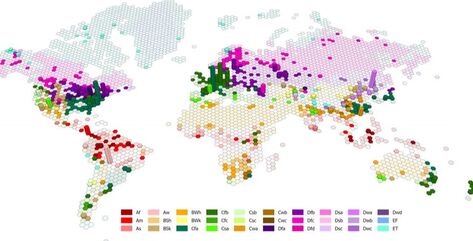 Figure. Distribution of root trait observations in FRED 3.0 across the globe; taken from Iversen and McCormack, https://doi.org/10.1111/nph.17326
Trait-based approaches provide a framework to investigate plant strategies for resource acquisition, growth, and competition, as well as plant impacts on ecosystem processes. Despite significant progress capturing trait variation within and among stems and leaves, identification of trait syndromes within fine-root systems and between fine roots and other plant organs is limited. This empirical roadblock is also partly responsible for the highly simplistic and descriptions of fine-root and belowground ecology in terrestrial biosphere models. With support from the Department of Energy’s Office of Biological and Environmental Research and in collaboration with Oak Ridge National Laboratory and Colleen Iversen, we compiled the Fine-Root Ecology Database (FRED) from published literature and unpublished data. For more information visit the FRED Website.
Relevant Publications
Iversen CM and ML McCormack. Filling gaps in our understanding of belowground plant traits across the world: an introduction to a Virtual Issue. New Phytologist, 231: 2097-2103 (2021).
Weigelt A, Mommer L, Andraczek K, Iversen...... ML McCormack. An integrated framework of plant form and function: The belowground perspective. New Phytologist 232: 42-59 (2021).
Laughlin D, L Mommer, FM Sabatini, H Bruelheide, TW Kuyper, ML McCormack,......A Weigelt. Root traits explain plant species distributions along climatic gradients yet challenge the nature of ecological trade-offs. Nature Ecology & Evolution, 5: 1123-1134 (2021).
McCormack ML*, MA Kaproth*, E Carlson, J Cavender-Bares, PG Kennedy. Climate and phylogenetic history structure morphological and architectural trait variation among fine-root orders. New Phytologist, 228: 1824-1834 (2020). *Authors contributed equally to this work.
Guerrero-Ramirez N, Mommer L, Freschet GT, Iversen CM, McCormack ML ...... A Weigelt. Global Root Traits (GRooT) Database. Global Ecology and Biogeography, 30: 25-37 (2020).
Bergmann J, A Weigelt, F van der Plas, DC Laughlin, TW Kuyper, N Guerrero-Rameriz, OJ Valverde-Barrantes, H Bruelheide, GT Freschet, CM Iversen, J Kattge, ML McCormack......L Mommer. The fungal collaboration gradient dominates the root economics space in plants. Science Advances, 6: eaba3756 (2020).
Kattge J, G Bönisch, S Díaz, S Lavorel, IC Prentice, P Leadley, S Tautenhahn, G Werner…ML McCormack...…C Wirth. TRY plant trait database - enhanced coverage and open access. Global Change Biology, 26: 119-188 (2020).
McCormack ML and CM Iversen. Physical and functional constraints on viable belowground acquisition strategies. Frontiers in Plant Science, 10: 1-12 (2019).
Caplan JS, SJ Meiners, H Flores-Moreno, ML McCormack. Fine-root traits are linked to species dynamics in a successional plant community. Ecology, 100: e02588 (2019).
McCormack ML, AS Powell, CM Iversen. Letter: Better plant data at the root of ecosystem models. Eos, (2018).
McCormack ML, D Guo, CM Iversen, W Chen, DM Eissenstat, CW Fernandez, L Li, C Ma, Z Ma, H Poorter, PB Reich, M Zadworny, AE Zanne. Building a better foundation....New Phytologist, 215: 27-37 (2017).
Iversen CM, ML McCormack et al.... A global Fine-Root Ecology Database to address belowground challenges in plant ecology. New Phytologist, 215: 15-26 (2017).
Freschet GT, OJ Valverde-Barrantes, CM Tucker, JM Craine, ML McCormack et al... Climate, soil and plant functional types as drivers of global fine-root trait variation. Journal of Ecology, 105: 1182-1196 (2017).
Relevant Publications
Iversen CM and ML McCormack. Filling gaps in our understanding of belowground plant traits across the world: an introduction to a Virtual Issue. New Phytologist, 231: 2097-2103 (2021).
Weigelt A, Mommer L, Andraczek K, Iversen...... ML McCormack. An integrated framework of plant form and function: The belowground perspective. New Phytologist 232: 42-59 (2021).
Laughlin D, L Mommer, FM Sabatini, H Bruelheide, TW Kuyper, ML McCormack,......A Weigelt. Root traits explain plant species distributions along climatic gradients yet challenge the nature of ecological trade-offs. Nature Ecology & Evolution, 5: 1123-1134 (2021).
McCormack ML*, MA Kaproth*, E Carlson, J Cavender-Bares, PG Kennedy. Climate and phylogenetic history structure morphological and architectural trait variation among fine-root orders. New Phytologist, 228: 1824-1834 (2020). *Authors contributed equally to this work.
Guerrero-Ramirez N, Mommer L, Freschet GT, Iversen CM, McCormack ML ...... A Weigelt. Global Root Traits (GRooT) Database. Global Ecology and Biogeography, 30: 25-37 (2020).
Bergmann J, A Weigelt, F van der Plas, DC Laughlin, TW Kuyper, N Guerrero-Rameriz, OJ Valverde-Barrantes, H Bruelheide, GT Freschet, CM Iversen, J Kattge, ML McCormack......L Mommer. The fungal collaboration gradient dominates the root economics space in plants. Science Advances, 6: eaba3756 (2020).
Kattge J, G Bönisch, S Díaz, S Lavorel, IC Prentice, P Leadley, S Tautenhahn, G Werner…ML McCormack...…C Wirth. TRY plant trait database - enhanced coverage and open access. Global Change Biology, 26: 119-188 (2020).
McCormack ML and CM Iversen. Physical and functional constraints on viable belowground acquisition strategies. Frontiers in Plant Science, 10: 1-12 (2019).
Caplan JS, SJ Meiners, H Flores-Moreno, ML McCormack. Fine-root traits are linked to species dynamics in a successional plant community. Ecology, 100: e02588 (2019).
McCormack ML, AS Powell, CM Iversen. Letter: Better plant data at the root of ecosystem models. Eos, (2018).
McCormack ML, D Guo, CM Iversen, W Chen, DM Eissenstat, CW Fernandez, L Li, C Ma, Z Ma, H Poorter, PB Reich, M Zadworny, AE Zanne. Building a better foundation....New Phytologist, 215: 27-37 (2017).
Iversen CM, ML McCormack et al.... A global Fine-Root Ecology Database to address belowground challenges in plant ecology. New Phytologist, 215: 15-26 (2017).
Freschet GT, OJ Valverde-Barrantes, CM Tucker, JM Craine, ML McCormack et al... Climate, soil and plant functional types as drivers of global fine-root trait variation. Journal of Ecology, 105: 1182-1196 (2017).